Built to the same standard as your work.
Konk Electrical's clients are architects, builders and homeowners who notice when a switch plate sits two mil out. We built their old site, they outgrew it, and they came back to us for the rebuild.

Websites for electricians and electrical contractors that show the standard of your work, get you found for rewires, EV chargers and smart homes, and sort the real enquiries from the time-wasters. Built by a Sheffield studio, for electricians anywhere in the UK.
Good electrical work mostly disappears behind a wall. What a customer sees is the switch plate, the lighting and the finish, and before any of that, the website. If the site looks like it was knocked up in an afternoon, people assume the wiring was too.
We build websites for electricians, electrical contractors and EV charger installers. Some of your customers are homeowners after a rewire, a new consumer unit or a charger on the drive. Some are builders and architects who need a contractor they can trust on a high-end job. Some are landlords who need an EICR. A good electrician's website gives each of them a clear way in.
Every site is custom, never a template. Project pages that show the finish, a page for each service and area, your NICEIC or NAPIT details where people check, and enquiry forms that ask the right questions before you spend time on a quote.
Each job gets its own page and gallery: the brief, the location and the photos. Konk Electrical's site has 13 of them, added from a Recent Work section in their dashboard.
Rewires, consumer units, EV chargers, lighting, smart home, testing and EICRs, commercial fit-outs. A page for each, so you're found for the work you want more of.
Domestic or commercial, the type of work, the property and the timeline, asked up front. QuickFit EV's form sorts the real buyers from the tyre-kickers before anything reaches the inbox.
NICEIC, NAPIT, OZEV approval, manufacturer partnerships, insurance and warranties, shown clearly instead of buried in the footer.
A page for each area you cover with its own local copy, the way Konk's site has a page for each of the five suburbs they work in.
Add a new project, swap a photo or change the words yourself without touching the design. Konk's editor lets them click on the words or a photo to change it.
Konk Electrical's clients are architects, builders and homeowners who notice when a switch plate sits two mil out. We built their old site, they outgrew it, and they came back to us for the rebuild.
No page builder underneath, so pages load quickly on a phone and there's no lag from the click to the next page. Fast was one of the five lines in Konk's brief.
We're a small team in Sheffield. You talk to the people building your site, and after launch changes get made quickly by people who already know it.
Straight answers to what electricians ask us before they start, and to what their customers check before they get in touch.
What you do, where you work, proof you're qualified and proof you're good. That means a page for each service, a page for each area, your NICEIC or NAPIT registration and Part P details, your insurance, your reviews and your own photos of finished work.
Then make getting in touch easy. A call button that stays on screen on a phone, and an enquiry form that asks enough to tell a rewire from a socket move, so you can price it properly or ring back with the right answer.
A homeowner wants to know you're safe to let in, tidy and fairly priced. Reviews, accreditations and photos of finished rooms do that.
A builder or architect wants to see the standard of high-end work and know you'll turn up when the programme says. Project pages with a proper write-up do that. A landlord or letting agent wants testing and certificates handled without fuss, and a clear page on EICRs and how to book one does that.
Most electricians do all three, so the site needs a clear route for each from the homepage.
EV charger customers do their homework. They want to know about approvals, chargers, cost, how long the install takes and whether their house is suitable. If the site answers those, the enquiry that comes in is a buyer, not a browser.
For QuickFit EV we built an enquiry flow that asks domestic or commercial, charger type and install location before anything lands in the inbox, alongside their OZEV approval, certifications and a gallery of recent installs.
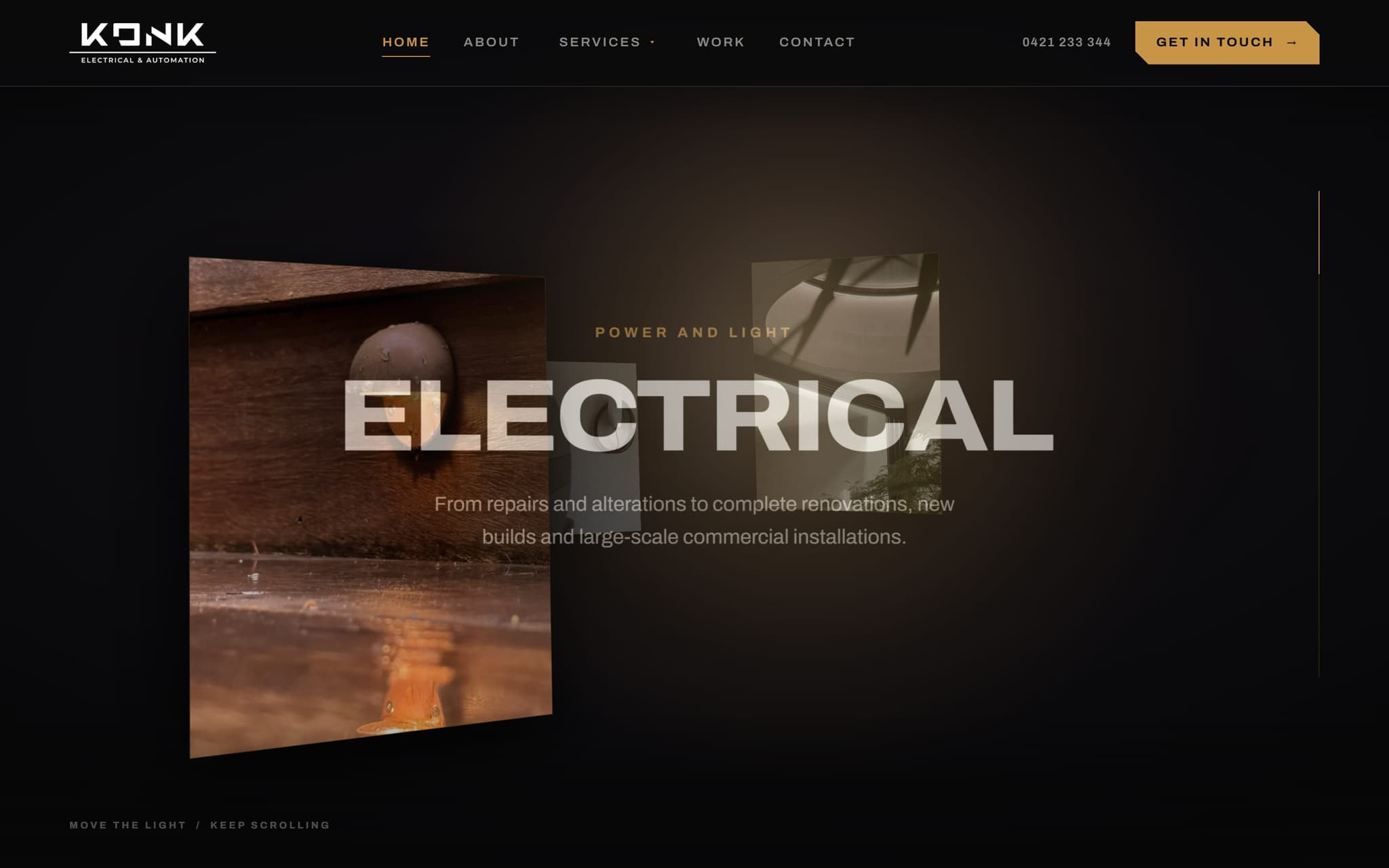
Konk Electrical wire high-end homes across Sydney's Eastern Suburbs. We built their old site a few years back, they'd outgrown it, and the brief was five lines: clean, bold, out of the ordinary, fast and to the point.
The homepage is one continuous scroll where their work comes towards you one trade at a time and lands on Send an enquiry. Behind it sit 13 project pages, a page for each of their 4 trades and 5 suburbs, their reels and Instagram pulled in, and a click-to-edit editor so they keep it up to date themselves.
The same way as any local trade: a page for each service and area you cover, the same business details everywhere, an active Google Business Profile and genuine reviews that mention the work you did.
We build the site side of that in, with your business marked up for Google and linked to your Business Profile, and every old page address pointed at its new page so you don't lose what you've already earned.

Alex Whitehead
Director, Developer & Award-Winning Web Designer

Beth Rendell
Director & Operations

Paul Rendell
Web Design & Development

Lahcen
Graphic Design
That comes down to the size of the site: how many services, areas and projects it shows, and whether it needs something like a qualifying enquiry flow. It's priced on scope after a free call, with a fixed number before we start.
Yes. We set up a project area where you add photos, a short write-up and the location. On Konk's site they add a project from a Recent Work section in the dashboard and it gets its own page and gallery.
Yes. QuickFit EV is one: domestic and commercial install routes, a form that qualifies the job before it reaches the inbox, and their approvals and certifications up front. Our EV and automotive page goes into it in more detail.
Yes. The homepage gives each a clear route, and the enquiry form asks which it is up front, so a homeowner and a facilities manager each see what matters to them.
Around 4 weeks for an AI-accelerated website of up to 5 pages, and 6 to 8 weeks for a fully bespoke site of up to 8 pages. Bigger builds with lots of projects get a clear timeline before we start.
A rebuild for an electrical and automation firm wiring high-end homes in Sydney.
Learn more →An EV charger installer's site that qualifies every enquiry before it lands.
Learn more →How we build for trades, from plumbers and electricians to locksmiths and joiners.
Learn more →Websites for EV charge point installers, garages and automotive specialists.
Learn more →Websites for plumbers and heating engineers that win the installs.
Learn more →Get into the Google map pack so people nearby find you first.
Learn more →Book a free 20-minute call. Tell us the jobs you want more of and we'll tell you straight what your website needs to win them.
See our 314 reviews on Trustpilot